
GOLD AWARD
__
BEST MENTAL HEALTH PROVIDER
|
MIDTOWN MAGAZINE DIAMOND AWARDS, 2025

GOLD AWARD
__
BEST MENTAL HEALTH PROVIDER
|
MIDTOWN MAGAZINE DIAMOND AWARDS, 2025
Uncertainty is exhausting. Whether you’re a parent trying to understand why your child is struggling, or an adult who has spent years wondering why certain challenges seem harder than they should, living without answers can leave you feeling frustrated, overwhelmed, and unsure where to turn. The right evaluation can provide the clarity you’ve been looking for.
At Calhoun Psychology, our evaluations are designed to do more than answer a single diagnostic question. We take the time to understand the whole person—their history, current concerns, strengths, and the many factors that may be influencing their functioning. Whether the goal is diagnostic clarification, understanding learning differences, identifying giftedness, determining school readiness, or informing educational or therapeutic planning, every evaluation is individualized to the questions that matter most.
The result is a comprehensive report that explains our clinical reasoning, highlights strengths alongside areas of need, and provides clear, practical recommendations to guide meaningful next steps.
Finding the right evaluation can feel overwhelming, especially when concerns involve learning, attention, emotional well-being, or development. At Calhoun Psychology, we provide thoughtful, comprehensive psychological assessments designed to answer meaningful clinical questions—not simply assign a diagnosis. Every evaluation is individualized to the referral concerns, integrates information from multiple sources, and results in practical recommendations that support informed decisions at home, in school, college, work, and in other contexts.
Explore our assessment services below to learn more.

Comprehensive ADHD evaluations for children, adolescents, college students, and adults that examine attention, executive functioning, and related concerns while carefully considering other conditions that may better explain the presenting difficulties.

Comprehensive evaluations to identify dyslexia, dysgraphia, dyscalculia, and other learning-related challenges while providing individualized recommendations, interventions, and accommodations.

A broad evaluation that examines how learning, cognition, attention, executive functioning, and mental health work together to understand academic performance and everyday functioning.

Assessment of intellectual abilities for gifted identification, academic planning, educational decision-making, and a deeper understanding of cognitive strengths.

Comprehensive evaluations to determine readiness for early admission to kindergarten while considering cognitive, academic, social-emotional, and developmental factors.
Webpage coming soon…
Need help selecting an evaluation?
Many individuals and families aren’t sure which type of evaluation best fits their concerns—and that’s completely okay. During your consultation, we’ll discuss your questions, review your goals, and help determine which evaluation is most likely to provide the answers you’re looking for.
Every person comes to us with different questions, goals, and concerns. One family may be seeking answers about attention or learning, while another wants to understand whether their child is ready for early kindergarten entry or qualifies for gifted services. Others may be looking for diagnostic clarification, educational planning, or documentation to support school or workplace accommodations.
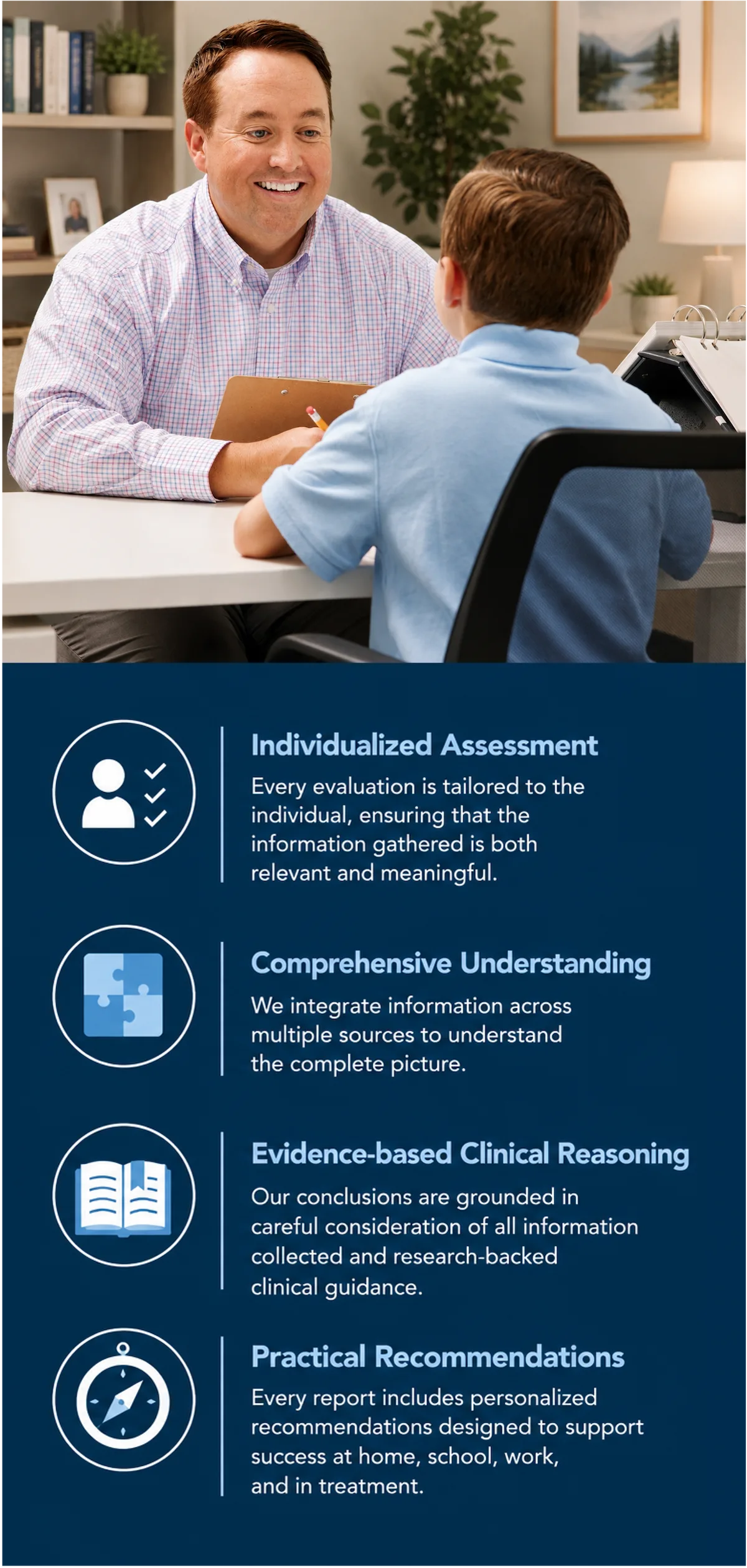
Although the purpose of each evaluation may differ, our approach remains the same. Every evaluation is individualized to the questions that matter most. Rather than relying on a one-size-fits-all testing battery, we carefully select assessment measures based on each person’s unique concerns, integrating clinical interviews, developmental and educational history, standardized testing, observations, rating scales, and information from parents, teachers, or other professionals when appropriate.
Our goal is not simply to generate scores or assign diagnoses. We strive to understand the whole person—identifying strengths alongside areas of need, explaining the factors contributing to current challenges, and providing clear, practical recommendations that help guide meaningful next steps.
Depending on your needs, this thoughtful approach may be applied through ADHD testing, learning disability and dyslexia testing, comprehensive psychoeducational evaluations, gifted and IQ testing, or early entry to kindergarten evaluations.


For individuals experiencing both learning challenges and psychological symptoms. This is our most comprehensive evaluation and includes cognitive (IQ) testing, achievement testing, surveys assessing psychosocial functioning, and diagnostic clinical interviews. This full psychoeducational evaluation is the best way to determine an individual’s learning strengths and areas of challenge, whether they meet criteria for a psychological disorder, and how learning abilities and psychological symptoms may jointly influence overall functioning.
For individuals experiencing learning-related challenges or a suspected learning disorder — including difficulties with reading, writing, math, memory, or attention. This evaluation assesses cognitive ability (IQ), achievement level, and ADHD-related difficulties. If mood, anxiety, or conduct problems are also present and unmanaged, a full psychoeducational evaluation would be more appropriate.
This evaluation is also used for giftedness screening. Requirements for gifted and talented programs vary by district — contact your child’s school for specific testing criteria before scheduling.
Families seeking school-based support can find NC-specific IEP and 504 guidance through the Exceptional Children Assistance Center (ECAC), and information about gifted program eligibility and AIG services through the NC Department of Public Instruction.



For individuals experiencing mood, anxiety, behavioral, or social difficulties. This evaluation assesses psychological symptoms and includes an examination of the behavioral patterns and factors that maintain or worsen existing difficulties. The assessment concludes with recommendations for specific therapeutic approaches that could be most helpful. A psychological evaluation is best suited for individuals without a history of learning difficulties, or individuals who are already successfully managing learning difficulties and need additional support with psychological symptoms.
For children and adults with concerns about attention, focus, organization, hyperactivity, or impulsivity. This evaluation offers a comprehensive assessment of ADHD symptoms and includes a psychosocial history review along with administration of an ADHD diagnostic interview, targeted symptom measures, and brief cognitive testing of attention, processing speed, and working memory. If an individual also presents with emotional, behavioral, or educational concerns — such as anxiety or specific learning challenges — a psychological, educational, or full psychoeducational evaluation may be recommended to ensure diagnostic accuracy.

For children who seem to be academically and developmentally ready for kindergarten but will not meet their school district’s standard age cutoff date. This evaluation includes a brief assessment of emotional, behavioral, and social functioning along with cognitive and achievement testing. Requirements for early entry vary by district — specific information about early entry requirements can be found at the links below or by contacting the registration or admissions coordinator for your child’s school district directly.
The following table summarizes the services typcially included in each type of evaluation.
<< scroll left-to-right >>
| Assessment Services | Early Entry to Kindergarten | Giftedness | ADHD(Standard) | Psychological | Educational | Full Psychoeducational |
|---|---|---|---|---|---|---|
|
Caregiver Intake |
30 mins |
30 mins |
1 hr |
1.5 – 2 hrs |
1 – 1.5 hrs |
1.5 – 2 hrs |
|
Youth/Adult Intake (8yo+) |
— |
— |
1 hr |
1.5 – 2 hrs |
1 hr |
1.5 – 2 hrs |
|
Play-based Assessment (<8yo) |
— |
— |
— |
30 – 45 mins |
— |
30 – 45 mins |
|
Caregiver Diagnostic Interview |
— |
— |
30 mins |
1 hr |
— |
1 hr |
|
Youth/Adult Diagnostic Interview |
— |
— |
30 mins |
1 hr |
— |
1 hr |
|
Academic Record Review |
✓ |
✓ |
✓ |
— |
✓ |
✓ |
|
Review Prior Evaluation Reports & Medical Records |
— |
— |
✓ |
✓ |
✓ |
✓ |
|
Reports from External Reporters |
✓ |
✓ |
✓ |
✓ |
✓ |
✓ |
|
Phone/Video Meeting with Educational or Healthcare Professionals |
Add-on |
Add-on |
Add-on |
Add-on |
Add-on |
Add-on |
|
Symptom Measures |
— |
— |
✓ |
✓ |
✓ |
✓ |
|
Cognitive Testing |
Brief |
Full |
Brief |
— |
Full |
Full |
|
Achievement Testing |
Brief |
Full |
— |
— |
Full |
Full |
|
Evaluation Report/Summary |
Summary |
Summary |
Report |
Report |
Report |
Report |
|
Feedback Session |
30 min |
30 min |
1 hr |
1 hr |
1 hr |
1 hr |
|
Number of Sessions |
1-2 |
2-3 |
2-4 |
2-4 |
3-4 |
4-5 |
|
Total Clinician Hours |
5-6 |
8-9 |
9-10 |
11-12 |
14-15 |
19-20 |
During a psychological assessment, a trained clinician administers tests, surveys, and/or clinical interviews with the goal of gaining a comprehensive understanding of an individual’s primary concerns. Results from assessments are often used to establish psychological diagnoses (learning disabilities, ADHD, mood/anxiety disorders, etc.) and generate tailored recommendations for parenting and self help strategies, instructional practices, and psychological therapies that will be most effective.
We begin by learning about your concerns, relevant history, and the questions you hope the evaluation will answer. The evaluation may then include clinical interviews, standardized tests, behavioral rating scales, and review of relevant records, with additional information gathered from parents, teachers, partners, or other important individuals when appropriate.
After the assessment, we thoughtfully integrate all sources of information to develop a comprehensive understanding of the individual, reach accurate diagnostic conclusions, and develop individualized recommendations. Finally, we meet with you to review the findings, answer your questions, and provide a comprehensive written report with practical recommendations for moving forward.
Assessments are often most helpful for a) identifying learning difficulties that may require a higher level of educational support, and b) assessing psychological symptoms and generating diagnoses that can be used to seek out appropriate therapeutic support. An assessment could be helpful for individuals who:
If you’re still not sure that an assessment is needed, you can always complete an initial intake to discuss any concerns you have and learn more about how a psychological assessment may or may not be the best next step.
Rather than following a one-size-fits-all approach, we tailor each evaluation to the questions being asked and the information needed to reach well-supported clinical conclusions. We’ll discuss the anticipated timeline with you during the scheduling process.
Yes. We offer evaluations for children, teens, college students, and adults. Many adults seek an evaluation after recognizing lifelong patterns of attention or executive functioning difficulties, experiencing increased demands at work or home, or after a child or family member receives an ADHD diagnosis. College students often pursue evaluations to better understand academic challenges or to obtain documentation for disability support services when appropriate.
Our evaluation process is individualized to reflect each person’s stage of life, responsibilities, and referral questions.
Yes. When supported by the evaluation findings, our reports include documentation that may be used to support requests for accommodations and other services in educational or workplace settings. Recommendations are individualized and based on the specific ways the individual’s symptoms affect everyday functioning. Depending on the evaluation findings, recommendations may support eligibility for 504 Plans or Individualized Education Programs (IEPs), specialized academic interventions, classroom accommodations, executive functioning supports, therapy, college disability accommodations, workplace accommodations, and other evidence-based services designed to address the individual’s unique needs.
While schools, colleges, testing agencies, and employers each establish their own eligibility criteria, our reports are designed to provide clear, well-supported clinical documentation that can support requests for accommodations and other services when appropriate.
Calhoun Psychology is a self-pay practice for psychological assessment services. Our self-pay model allows evaluations to be individualized based on clinical needs rather than insurance requirements or predetermined testing limitations. This flexibility allows us to recommend the assessment approach that best addresses each individual’s unique referral questions rather than tailoring the evaluation to insurance coverage criteria.
If your evaluation is completed by one of our Licensed Psychologists, we can provide a superbill that you may submit to your insurance company to request possible out-of-network reimbursement. Because reimbursement policies vary widely by insurance plan, we recommend contacting your insurance provider directly to determine your specific out-of-network benefits.
To help make comprehensive psychological evaluations more accessible, we also offer reduced-fee evaluations completed by doctoral-level psychology interns and postdoctoral clinicians who are closely supervised by our Licensed Psychologists. While these clinicians receive extensive supervision and all evaluation findings are reviewed by a licensed psychologist, services provided by interns or postdoctoral clinicians are generally not eligible for out-of-network insurance reimbursement.