GOLD AWARD
__
BEST MENTAL HEALTH PROVIDER
|
MIDTOWN MAGAZINE DIAMOND AWARDS, 2025

GOLD AWARD
__
BEST MENTAL HEALTH PROVIDER
|
MIDTOWN MAGAZINE DIAMOND AWARDS, 2025
Learning, attention, and emotional well-being rarely exist in isolation. Strengths and challenges in one area often influence functioning in another, making it difficult to understand what is truly contributing to an individual’s overall functioning and well-being.
For example, a child with an undiagnosed learning disorder may become increasingly anxious as academic demands grow. Another individual may appear inattentive because they are overwhelmed by anxiety or depression rather than ADHD. Likewise, attention or executive functioning difficulties may contribute to frustration, reduced confidence, and emotional distress over time. These patterns often overlap, making it essential to understand not only what challenges are present, but also how they influence one another. Because these concerns often overlap, looking at any one symptom, diagnosis, or area of functioning in isolation may not provide the full picture.
A psychoeducational evaluation is designed to understand how learning, cognitive abilities, attention, executive functioning, emotional functioning, and other aspects of development work together to shape an individual’s daily experiences, relationships, academic performance, and overall well-being.
Our goal is not simply to identify diagnoses or measure academic skills. It is to develop a meaningful understanding of the individual’s unique pattern of strengths and challenges so recommendations can be thoughtfully tailored to support success at school, home, college, work, and in everyday life.
“Meaningful answers come from understanding the whole picture.”
A psychoeducational evaluation thoughtfully integrates information across learning, cognition, attention, emotional functioning, and everyday experiences to develop a meaningful understanding of the whole person and provide personalized recommendations that support long-term success.
A psychoeducational evaluation may be helpful when learning, attention, or emotional concerns are affecting academic performance, confidence, or overall well-being—and it isn’t clear what is driving those challenges.
You may benefit from a psychoeducational evaluation if you are experiencing any of the following:




A psychoeducational evaluation should do more than identify diagnoses or describe academic performance. It should answer the questions that help individuals, families, educators, and healthcare providers make informed decisions about support, intervention, and future planning.
Every evaluation is guided by the individual’s unique referral questions and concerns. Rather than applying the same evaluation process to everyone, we thoughtfully tailor each assessment to gather the information needed to answer the questions that matter most—providing meaningful insights that support informed decisions at home, in school, and beyond.
No two individuals learn, think, or experience the world in exactly the same way. That’s why we believe every psychoeducational evaluation should be guided by the individual’s unique referral questions, history, strengths, and areas of concern rather than a one-size-fits-all testing battery.
Our evaluations integrate information from multiple sources—including clinical interviews, developmental history, behavioral observations, standardized tests, rating scales, school or medical records, and input from parents, teachers, and other professionals when appropriate. Each source contributes an important piece of the overall picture.
Rather than interpreting each source of information in isolation, we thoughtfully integrate findings across domains to understand the meaningful patterns that emerge. These patterns provide a more complete understanding of the individual than any single test score or diagnosis alone and form the foundation for individualized conclusions and recommendations.
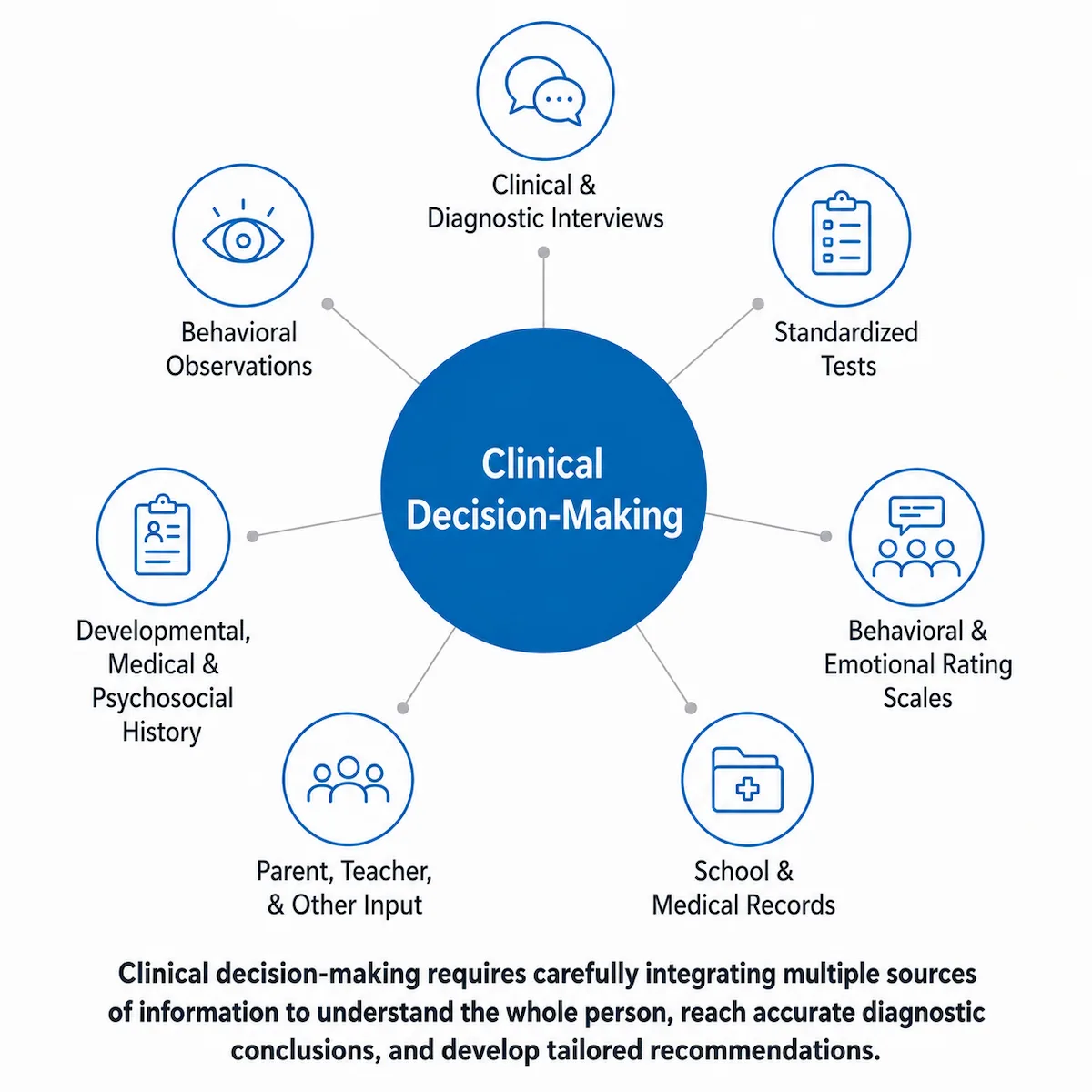
Our goal is for every individual and family to leave the evaluation with more than a diagnosis or a collection of test scores. We strive to provide meaningful answers, practical recommendations, and a clear path forward.
You’ll receive a detailed report summarizing the evaluation findings, diagnostic conclusions (when applicable), and individualized recommendations. Our reports are designed to be practical resources that can be shared with healthcare providers, schools, colleges, or employers when appropriate.
Following the evaluation, we’ll meet with you to review the findings, explain how we reached our conclusions, answer your questions, and discuss recommendations in clear, understandable language. We believe feedback should be collaborative, educational, and tailored to your unique concerns—not simply a review of test scores.
Recommendations are tailored to the individual’s unique strengths, challenges, and goals. Depending on the evaluation findings, recommendations may include:
Perhaps most importantly, you’ll leave with a deeper understanding of why challenges are occurring, how they affect everyday functioning, and what supports are most likely to help. Our goal is to provide the clarity needed to make informed decisions and move forward with confidence.

Every evaluation begins with a comprehensive clinical interview to better understand the individual’s developmental history, current concerns, educational experiences, and goals for the evaluation. Based on the referral questions, we thoughtfully select assessment measures that may include cognitive, academic, attention, executive functioning, emotional, behavioral, adaptive functioning, or other areas relevant to the evaluation.
Once testing is complete, we carefully integrate information from interviews, observations, records, rating scales, and standardized assessment to develop individualized conclusions and recommendations. You’ll then receive a comprehensive written report and participate in a personalized feedback session where we’ll review the findings, answer your questions, and discuss recommendations in clear, understandable language.
The length of the evaluation depends on the referral questions and the complexity of the concerns being assessed. Most psychoeducational evaluations involve an intake appointment, one or more testing sessions, and a feedback session to review the findings. During your initial consultation, we’ll discuss the anticipated timeline and evaluation process based on your specific needs.
A psychoeducational evaluation is often recommended when concerns extend beyond a single area or when it isn’t clear what factors are contributing to learning, attention, emotional, or behavioral difficulties. More focused evaluations—such as ADHD, learning disability, or psychological evaluations—may be appropriate when the referral questions are more specific.
If you’re unsure which type of evaluation is the best fit, we’ll discuss your concerns during the intake process and recommend the evaluation that best addresses your needs.
Yes. We provide psychoeducational evaluations for college students and adults when the referral questions extend beyond a single area of concern or when a comprehensive understanding of learning, cognitive functioning, attention, and emotional functioning is needed.
For college students, psychoeducational evaluations are often appropriate when there are longstanding questions about how learning differences combine with ADHD or other psychological symptoms. These evaluations may also provide documentation to support requests for disability accommodations, when appropriate.
For adults who are no longer in school, a full psychoeducational evaluation is typically recommended only when there are broader questions about cognitive functioning, suspected learning differences, or complex concerns affecting work performance or everyday functioning. In many cases, a more focused evaluation—such as an ADHD evaluation or psychological evaluation—may be a better fit.
If you’re unsure which type of evaluation best addresses your concerns, we’ll discuss your goals during the intake process and recommend the option that is most appropriate for your situation.
Yes. When supported by the evaluation findings, our reports include documentation that may be used to support requests for accommodations and other services in educational or workplace settings. Recommendations are individualized and based on the specific ways the individual’s symptoms affect everyday functioning. Depending on the evaluation findings, recommendations may support eligibility for 504 Plans or Individualized Education Programs (IEPs), specialized academic interventions, classroom accommodations, executive functioning supports, therapy, college disability accommodations, workplace accommodations, and other evidence-based services designed to address the individual’s unique needs.
While schools, colleges, testing agencies, and employers each establish their own eligibility criteria, our reports are designed to provide clear, well-supported clinical documentation that can support requests for accommodations and other services when appropriate.
Calhoun Psychology is a self-pay practice for psychological assessment services. Our self-pay model allows evaluations to be individualized based on clinical needs rather than insurance requirements or predetermined testing limitations. This flexibility allows us to recommend the assessment approach that best addresses each individual’s unique referral questions rather than tailoring the evaluation to insurance coverage criteria.
If your evaluation is completed by one of our Licensed Psychologists, we can provide a superbill that you may submit to your insurance company to request possible out-of-network reimbursement. Because reimbursement policies vary widely by insurance plan, we recommend contacting your insurance provider directly to determine your specific out-of-network benefits.
To help make comprehensive psychological evaluations more accessible, we also offer reduced-fee evaluations completed by doctoral-level psychology interns and postdoctoral clinicians who are closely supervised by our Licensed Psychologists. While these clinicians receive extensive supervision and all evaluation findings are reviewed by a licensed psychologist, services provided by interns or postdoctoral clinicians are generally not eligible for out-of-network insurance reimbursement.
Copyright © 2026 Calhoun Psychology. All rights reserved.